Brazen Weekender: Drone Narco Subs, the Pardon Market, and a French Spy's Second Life
by Bradley Hope
/
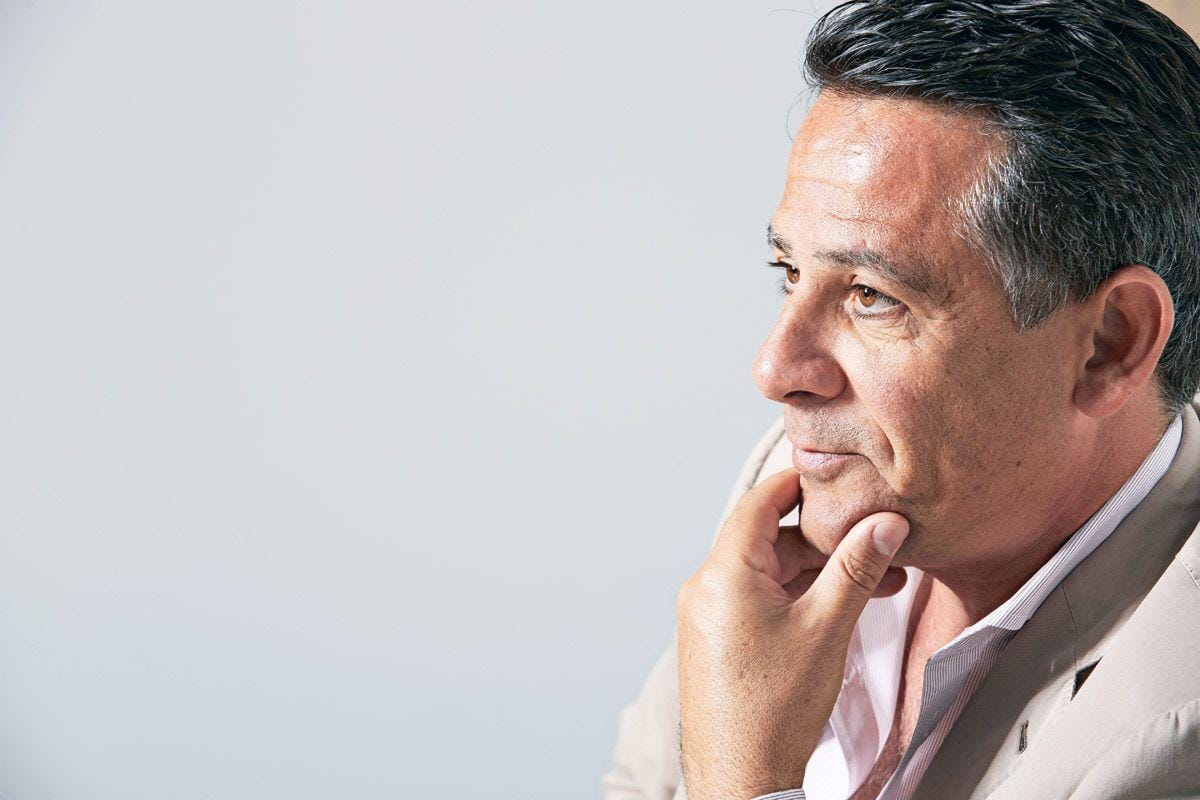
A tip led us to a mysterious Dubai fund. What we found was a network connecting a money launderer, an insolvent UK company, a £100,000 political donation, the Dubai ruling family, and the UAE Finance Minister.
Welcome to Whale Hunting, where we follow the money behind some of the world's most brazen financial crimes and expose the networks of people who enable them.
Over the past year, Whale Hunting has been tracking the network behind Benjamin Mauerberger, the South African fugitive at the center of a $1.5 billion money laundering operation. This is wealth built on the back of industrial-scale "pig butchering" compounds in Cambodia, where trafficked laborers are forced to defraud thousands of Americans of their life savings.
Our reporting helped expose how this money infiltrated the highest levels of power, leading to the resignation of a Thai deputy finance minister after we revealed his wife received $2.9 million in Tether from the network. In December 2025, following our investigation, Thai authorities moved to seize over $300 million in assets — including luxury yachts, supercars, and millions in stocks —linked directly to Mauerberger’s operations. U.S. Homeland Security launched a manhunt. But Mauerberger himself vanished.
Now a fugitive, he has resurfaced in Dubai, where the network is attempting its most sophisticated maneuver yet: a full-scale professionalization. A tip from a source in the Dubai financial sector pointed us toward a new vehicle registered in the DIFC in early 2025. This source claimed the firm was founded by a high-profile luxury real estate CEO with deep ties to Mauerberger and a curious £100,000 political donation in the UK.
We started pulling threads. The trail unraveled a story far bigger than a single scam. It led from the public filings of a bankrupt London company to the inner circle of Dubai’s ruling family and the office of the UAE’s sitting finance minister.
This is the story of the global enablers: powerful business people, political figures, and offshore specialists who operate in the blur between high finance and big-money politics. It reveals how a company drowning in debt can funnel six figures into a British political party, and how a money launderer and a luxury real-estate CEO can be separated by just one degree.
This is the Mauerberger network in Dubai. And this is how we mapped it.
Get the full story—free with your email.
This story is open to all and our work is available for free to anyone who signs up with their e-mail. But investigations like this aren’t cheap. If you believe accountability journalism matters, consider upgrading to a paid subscription – or sending a one-time boost. Every contribution directly funds more reporting like this.
Have a tip? Reach us at:
📩 whalehunting@projectbrazen.com
📧 projectbrazen@protonmail.com
🔒 Secure contact details here.
We protect our sources.
It started, as these things often do, with a phone call. A source who had been following our Mauerberger coverage reached out. The source worked in Dubai's financial sector and had direct knowledge of a company that, the source claimed, was the latest vehicle in Mauerberger's network. The source described a regulated fund manager in the Dubai International Financial Centre, founded in early 2025, whose authorized individuals included people we had already written about. The source also described a suspicious $140 million investment proposal that had been made to a separate, legitimate fund, a formal Suspicious Activity Report filed with Dubai regulators, and a system that had looked the other way.
Our first stop was the DFSA Public Register, the public database maintained by the Dubai Financial Services Authority that lists every regulated firm and every individual authorized to work in the DIFC. The tip was correct. Sovereign Capital Limited had been licensed on June 24, 2025, as a Category 3C fund manager. It was authorized to manage collective investment funds, advise on financial products, and arrange deals in investments. On paper, it looked like any other boutique fund manager in the DIFC. It had stated capital of $2.7 million. It had no website, no marketing materials, no public track record. It was a blank slate.
But the list of founding authorized individuals told a very different story.
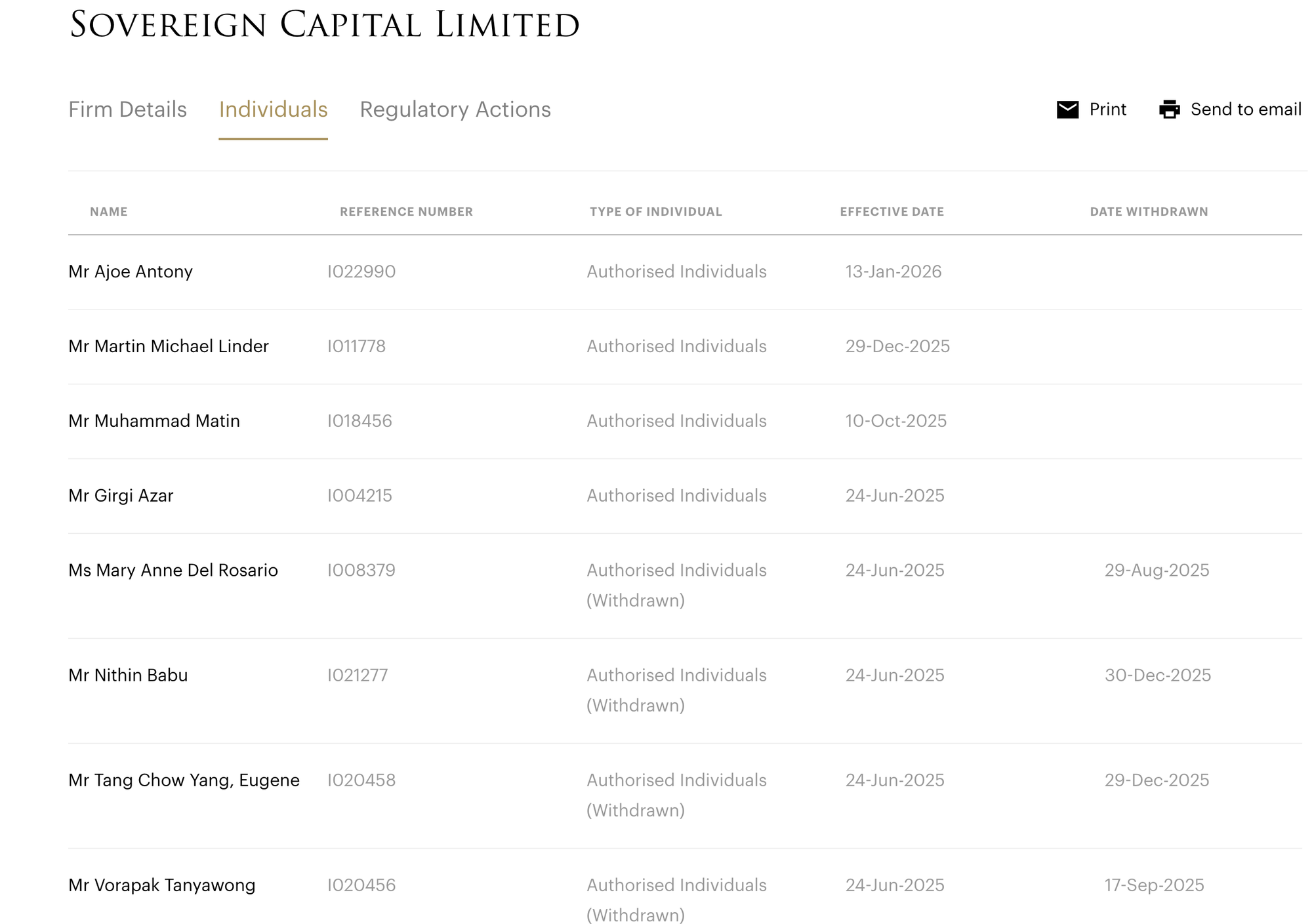
There were three names. The first was Vorapak Tanyawong, DFSA reference I020456, authorized on June 24, 2025, and withdrawn on September 17, 2025. Whale Hunting readers will recognize the name. Vorapak was the Thai Deputy Finance Minister who resigned in disgrace in October 2025 after our reporting revealed that his wife, Kanokporn Seetavorarat, had received $2.9 million in Tether cryptocurrency from a fund collateralized by shares in Finansia X, the Thai investment bank that Mauerberger had boasted about taking over. Vorapak had declared 1.4 billion baht ($45 million) in assets to Thailand's anti-corruption commission, an extraordinary sum. He was one of the most prominent casualties of the Mauerberger network's collapse.
The second name was Eugene Tang, DFSA reference I020458, also authorized on June 24, 2025, and withdrawn on December 29, 2025. Tang is the CEO of Capital Asia Investments, or CAI, Mauerberger's primary investment vehicle in Singapore. CAI was the fund that held the Finansia X shares, the fund through which Vorapak's wife had been paid, the fund at the center of the entire Southeast Asian operation. Tang was not a peripheral figure. He was Mauerberger's top financial lieutenant.
And then there was the third name: Girgi Azar, DFSA reference I004215, also authorized on June 24, 2025. Still active. "Girgi" is the Arabic form of "George." This was George Azar, the Chairman and CEO of Sotheby's International Realty in Dubai and the United Kingdom.
Azar was not a replacement who came in later, after the network's more notorious members had departed. He was a founding member of a company appointed on the same day as two of Mauerberger's closest associates. The three of them had sat down together, filed the paperwork, and launched a regulated financial firm in Dubai's most prestigious financial center. The DFSA had approved all three of them on the same date.
As the Mauerberger network collapsed under the weight of our reporting and law enforcement action in Thailand, Vorapak and Tang exited Sovereign Capital in sequence. Vorapak resigned on September 17, 2025, a month before he quit his government post. Tang resigned on December 29, 2025, and sold his shares a month later. Their departures tracked precisely with the escalating scrutiny on the Mauerberger network. Each man left as the spotlight moved closer to him.
That left George Azar in control of Sovereign Capital. But he would not be alone for long. A new partner was about to arrive, and his identity would raise even more questions.
Before we could understand what Sovereign Capital was doing, we needed to understand the man who controlled it.
On the surface, George Azar is a successful luxury real estate executive. He is the Chairman and CEO of Sotheby's International Realty in both Dubai and the United Kingdom, one of the most recognized luxury property brands in the world. His firm claims to have brokered over $5 billion in transactions in Dubai alone, growing from $60 million when he took over in 2013. In the UK, he claims to have brokered over £600 million in property deals in 2024. He appears at industry events, poses for magazine profiles, and presents himself as a man who has made it in the world of ultra-luxury property. His LinkedIn lists previous roles at Union Bancaire Privée, the Swiss private bank, and Merrill Lynch.
The public record tells a different story.
Official UK filings at Companies House show that Azar uses at least three different nationalities across his various corporate registrations. He is Lebanese by origin. He holds a Hungarian passport, which gives him the right to live and work anywhere in the European Union. And for his UK company filings as a Person with Significant Control, he uses an Antiguan passport, the kind purchased through Antigua and Barbuda's Citizenship by Investment program. The program requires a minimum donation of $100,000 to a national development fund, or a $200,000 investment in an approved real estate project. In return, the applicant receives a passport and full citizenship, with no requirement to live in the country. The use of so-called "golden passports" is a recurring feature in money laundering cases, and Antigua's program in particular has been repeatedly flagged by the Financial Action Task Force, the Caribbean Financial Action Task Force, and the U.S. State Department. It is not illegal to hold such a passport. But for compliance professionals, it is a red flag that demands further scrutiny.
While Azar was establishing Sovereign Capital in Dubai, his UK business interests were taking a strange political turn. On August 27, 2025, United Kingdom Sotheby's International Realty Limited, a company controlled by George Azar, donated £100,000 to Reform UK, the political party led by Nigel Farage. The donation is recorded on the Electoral Commission's public register under reference C0833720, accepted on August 27, 2025, and reported on October 30, 2025.
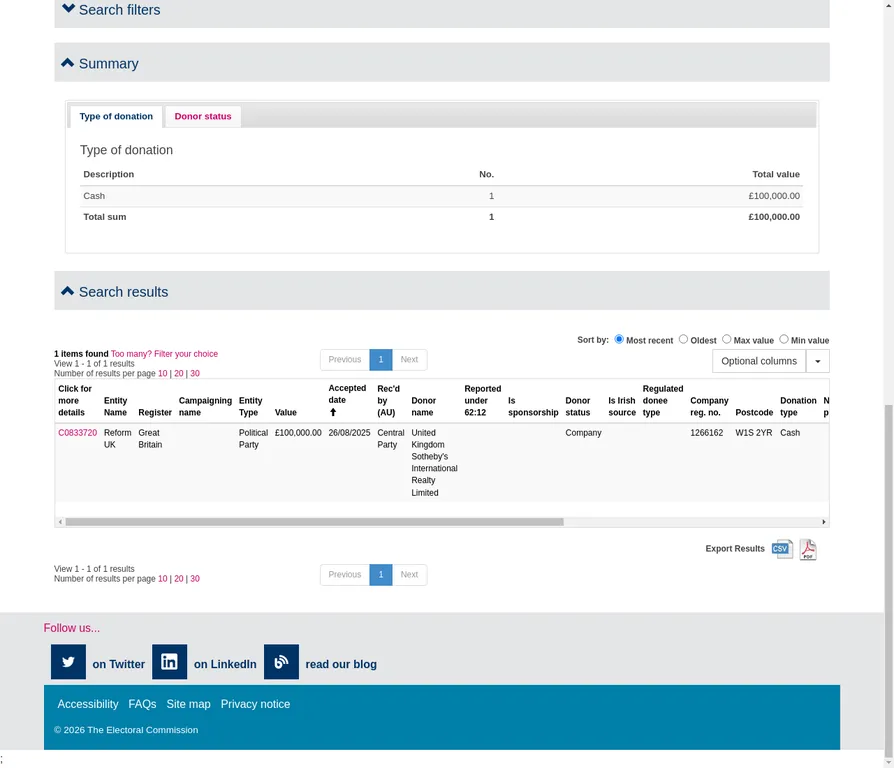
There was just one problem. The company making the donation was, and is, technically insolvent.
We pulled the company's most recent audited accounts from Companies House, the UK's public registry of corporate filings. The numbers, signed off by Azar himself, are stark. As of year-end 2023, the company had net liabilities of £12,848,582. That means its debts exceeded its assets by nearly £13 million. Total creditors stood at £21,249,101, a figure that had ballooned from £5.6 million the previous year. The auditors, confronted with these numbers, issued a "going concern" warning, formal language meaning they had serious doubts about the company's ability to continue operating.
The largest single creditor was an unnamed "connected company" to which the firm owed £15,987,633. The auditors explicitly state in the going concern notice that the business is entirely dependent on this connected company's continued financial support to survive. Without it, the company would collapse.
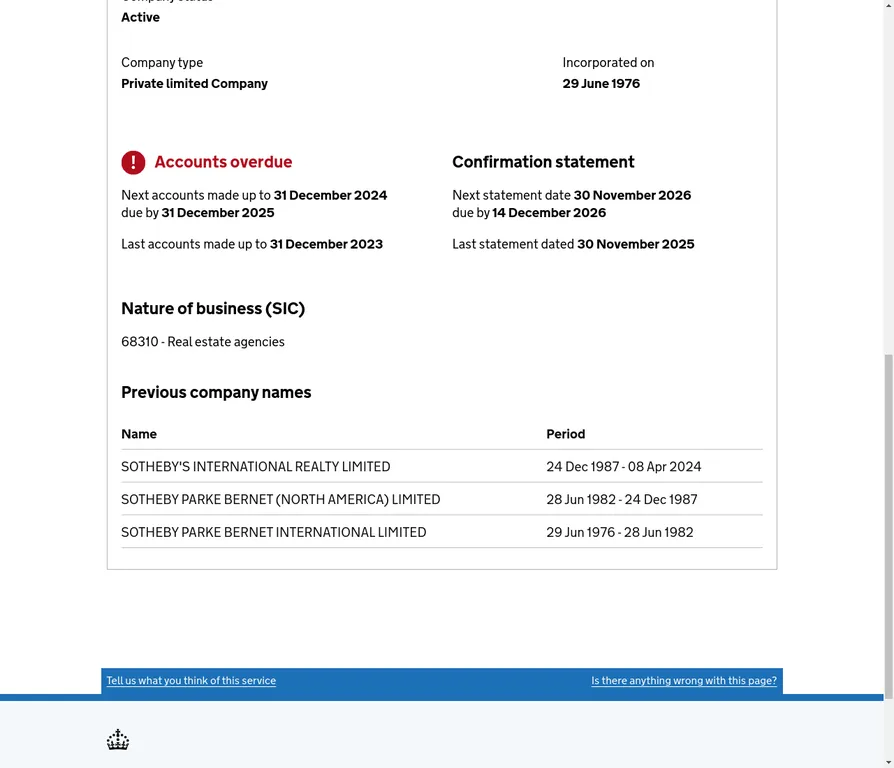
This connected company is almost certainly Azar's profitable Dubai operations. The effect is that Middle Eastern money is propping up a technically bankrupt UK firm. And that technically bankrupt UK firm, kept alive only by the grace of its offshore parent, donated £100,000 to a British political party.
As of February 2026, the company has failed to file its accounts for the year ending December 2024, a breach of UK corporate law. Companies House shows the accounts as overdue. The company also owes approximately £1 million to HMRC, the UK tax authority, and £1.5 million to trade creditors.
The legal implications are serious. Under UK law, when a company is insolvent or on the verge of insolvency, the directors' primary duty shifts from shareholders to creditors. Section 172(3) of the Companies Act 2006 requires directors to act in the interests of creditors when the company is insolvent or likely to become insolvent. Making a £100,000 political donation when the company owes creditors over £21 million could be viewed as a breach of this duty. If the company were to enter formal insolvency proceedings, a liquidator could seek to claw back the donation as a transaction at an undervalue under Section 238 of the Insolvency Act 1986, or as a preference under Section 239, or as misfeasance under Section 212. The two-year period for such claims would extend to August 2027.
There is also the question of due diligence on the part of Reform UK. The Electoral Commission's guidance states that political parties should make "extra checks" when a corporate donor's accounts are overdue or when there are red flags about its financial status. Reform UK reportedly rejected £193,000 from other donors during this period due to compliance concerns. The company's financial distress was a matter of public record. Anyone who searched Companies House would have found the going concern warning, the £13 million negative equity, and the overdue accounts.
The £100,000 gift to Reform UK highlights a striking disparity: while Azar’s UK business is technically insolvent and facing overdue accounts, his Dubai operations appear to be the profitable engine of his empire. But by early 2025, there was a new factor in the mix. Benjamin Mauerberger was in Dubai with a reported billion-dollar fortune to manage, and he required a bridge into the city’s elite financial circles. In George Azar, he found a partner with the institutional presence he lacked.
Before the two men ever formalized their partnership via Sovereign Capital, Azar appears to have acted as a door-opener. According to our source, it was Azar who introduced Mauerberger to Global Partners Limited, a DFSA-regulated fund manager that serves as the private investment vehicle for the family of Sheikh Butti bin Maktoum bin Juma Al Maktoum, the brother-in-law of Dubai’s ruler.
Mauerberger proposed investing $140 million in Global Partner's property fund, which would have represented roughly a third of the assets under management. The source said the proposal was suspicious from the start. But it was supported by Martin Linder, the CEO of Global Partners, who had gotten to know Mauerberger through Azar.
Martin Linder is a Swiss attorney and fund manager with an impressive institutional pedigree. He began his career as an analyst at Goldman Sachs in 2000. He spent nearly a decade at Partners Group, the Swiss private equity firm with over $100 billion in assets under management, rising to the level of Director. He then moved to Bank Vontobel, another major Swiss institution. In 2019, he founded Ellington Capital Limited in the DIFC, and in 2020, he became the founder and CEO of Global Partners.
With Linder's backing, the network moved $40 million into the fund. Though Mauerberger’s name was absent from subscription documents — the capital was funneled through Capital Asia Investments and his wife, Cattaliya Beevor —the relationship was personal. Sources say Linder met with Mauerberger regularly, overseeing the entry of a man whose history as a convicted 'boiler-room' operator was a matter of public record.
Azar also introduced Mauerberger to H&H Development LLC, a Dubai-based property company founded in 2007, according to our source. After fleeing Bangkok in October, after police named him as a central node in a Cambodian scammer network, Mauerberger has been living in a luxury development in Dubai Jumeirah Garden City called Eden House, which is developed by H&H. The source also claimed that Mauerberger has a significant stake in Janu Dubai, a luxury hotel and residential development in the DIFC being built by H&H in partnership with the Aman Group, scheduled to open in 2027.
We looked into who owns H&H Development. The company was co-founded by two men: Shahab Lutfi Harmoozi and Mohamed Al Hussaini.
Mohamed Al Hussaini is the sitting UAE Minister of State for Financial Affairs, one of the most powerful economic positions in the Emirates. He also sits on the boards of Emirates NBD, one of the UAE's largest banks, and the Investment Corporation of Dubai, the sovereign wealth fund of the Emirate of Dubai. He is a member of the UAE's Financial Stability Committee and the Ministerial Committee for Legislation. He holds a Master's degree from the London School of Economics and was previously the Director of the Budget Department at the UAE Ministry of Finance.
The Janu Dubai development is one of the most anticipated luxury projects in the DIFC. If Mauerberger holds a stake in this project, it would represent a direct financial link between a money launderer and a development co-owned by a company whose co-founder is the UAE's finance minister. We have not been able to independently verify the ownership claim.
Another source told us that Aman CEO Vladislav Doronin, who owns the Janu brand, and Mauerberger were planning to co-develop a Janu hotel near Phuket in Thailand. In Bangkok, Mauerberger lived in the Aman Nai Lert, where he kept Picassos and Warhol paintings – all now stripped out after he fled to Dubai. He also owns an apartment in the Aman New York, opposite Trump Tower on 5th Avenue.
Mauerberger’s presence within the royal-backed fund and the Finance Minister's property developments suggests an infiltration that reached the very top of Dubai’s establishment. For his part, Mauerberger has characterized himself as a legitimate participant in global financial markets, with no involvement in alleged scam networks. But while he maintained the posture of a regular investor, a quiet alarm was already beginning to sound behind the scenes.
In October 2025, the first crack in the network’s institutional veneer appeared. As public scrutiny of the Mauerberger network intensified, a formal Suspicious Activity Report (SAR) was filed with the UAE’s Financial Intelligence Unit (FIU) regarding the network’s assets in Dubai.
In a functioning oversight system, a SAR involving a high-profile money laundering network should have triggered an immediate freeze of assets by the authorities. Instead, the process stalled. While the FIU and the DFSA remained silent, a window was left open for the network to move its wealth.
Just days after the SAR was filed, Mauerberger’s wife, Cattaliya Beevor, filed papers to transfer her $40 million stake in a Dubai-based property fund to a nominee financier. By January 2026, the transfer was completed, allowing her to exit and cash out — all while the authorities took no action to stop the flow of funds.
Before Christmas, Martin Linder sold his shares in Global Partners, according to official corporate filings. A few days later, on Dec. 29, 2025, the DFSA Public Register shows he was authorized at Sovereign Capital — the finance vehicle founded by George Azar and Mauerberger lieutenants Vorapak Tanyawong and Eugene Tang. On that same day, the register confirms Eugene Tang resigned, and official records show he sold his shares in Sovereign Capital on Jan. 26, 2026, to Azar and Linder.
In an emailed response, Linder claimed that the allegations regarding his time at Global Partners contained "serious factual inaccuracies," though he declined to specify what those were, citing fiduciary duties to his former firm. He added that "the inclusion in your proposed article of personal references to me, and the attribution of personal responsibility to me for anything untoward, is entirely misplaced." He wrote that his sale of shares in Global Partners and exit from the business "had no connection or link whatsoever to Mr. Mauerberger or the alleged events you describe." He described Sovereign Capital as merely a "shelf company...without assets or revenues," which he purchased with George Azar "in order to expedite the process of getting back into business, as a convenience and for no other reason."
While Linder’s claim of no assets likely refers to the absence of third-party client funds, it ignores the firm's significant corporate war chest. At the time of the transition, Sovereign Capital was already a heavily capitalized Category 3C DFSA-registered fund manager, an institutional vehicle that required significant regulatory vetting to activate. Far from an empty shell, records show the firm holds $2.7 million in issued and paid-up share capital — nearly twenty times the minimum requirement for its license category. In the DIFC, such capital must be physically deposited and verified by an auditor before a license is activated.
He didn't respond to questions about his relationship with Mauerberger or why he bought shares in Sovereign Capital from Eugene Tang, a known associate of Mauerberger whose capital had been subject to scrutiny at Global Partners. By January, when this share transaction occurred, Eugene Tang's role as a front for Mauerberger was widely reported. A month earlier, Thai authorities had named Mauerberger as a key money laundering figure in a Cambodian scam network and moved to seize over $300 million in his network's assets.
The picture that emerges of Linder is a man who built a legitimate career at blue-chip institutions, founded a fund for one of Dubai's most powerful families, and then — according to our source — was drawn into the orbit of a money laundering network, eventually leaving the royal fund to join a company founded by the network's associates. George Azar, meanwhile, provided the network’s bridge to the prestige of the Sotheby’s brand and London’s elite property markets. Unlike Linder, he was there at the start, co-founding Sovereign Capital alongside Mauerberger’s lieutenants on the same day the firm was licensed.
In January 2026, shortly after Linder's arrival, Sovereign Capital appointed Ajoe Antony as its new Compliance Officer and Money Laundering Reporting Officer. Antony holds the Certified Anti-Money Laundering Specialist (CAMS) designation from ACAMS, the global standard for AML professionals. He previously worked at TMF Group, a major corporate services provider. Hiring an AML specialist after two of your founding members, both directly linked to a criminal money laundering network, have departed is a particular kind of timing.
A second new hire, Muhammad Matin, joined as a finance officer. Matin also previously worked at TMF Group. Sovereign Capital appears to be rebuilding itself from the ground up, replacing Mauerberger's associates with corporate services professionals.
The quiet professionalization of Sovereign Capital — the hiring of AML specialists and the installation of a Goldman Sachs alumnus as director — serves a specific purpose. By the time a regulator or a bank looks at Sovereign, they no longer see the disgraced Thai minister or the Singaporean lieutenant. They see a Swiss attorney, a luxury real estate mogul, and a compliance officer with global credentials.
Even if the original architects of the $1.5 billion criminal network have sold out, the transaction itself remains the story. By purchasing the shares of Eugene Tang, a known associate of Benjamin Mauerberger in January 2026 — weeks after his public designation by a sovereign state — these professionals did more than buy a company. They provided a clean exit for the network’s financial lieutenant, cashing him out of a regulated firm and replacing him with high-profile professional names. This transition effectively integrated a vehicle built on the proceeds of crime into the heart of the global financial system.
Here is what we can prove through public records and direct testimony:
Here is what we cannot prove:
What we can say is this: The connections between a global fugitive, a luxury real estate CEO, a Swiss fund manager, and the circles surrounding Dubai’s financial and political establishment are not a matter of theory. They are documented in public registries, court records, and stock exchange filings.
The story of Benjamin Mauerberger reveals a system where high-finance enablers can bridge the gap between a $1.5 billion crime and the heart of global power.
We have sought comment from George Azar, Vladislav Doronin, Global Partners, H&H Development, Sovereign Capital Limited, and Reform UK. We will update this story with any responses received.
This investigation was conducted using publicly available records from UK Companies House, the DFSA Public Register, the ICIJ Offshore Leaks Database, the BVI Financial Services Commission, the UK Electoral Commission, the DIFC Courts, WIPO, and Geneanet. All claims are sourced and verifiable.
If you have information about this story or any other, you can reach us securely at whalehunting@projectbrazen.com.
Got a question or a tip for us? Get in touch at whalehunting@projectbrazen.com. You can also contact us securely here.
You can also follow Whale Hunting on Instagram, Threads and on X (Twitter). To chat with fellow Whale Hunters and stay in touch with Bradley and Tom, join our Discord server.
For unlimited access to Whale Hunting’s investigative reporting, consider signing up for a paid subscription. You’ll get special editions of the newsletter and the Weekender, as well as premium podcast access and discounted merch.
Enjoying Whale Hunting but not ready to subscribe? Show your support by leaving a tip (via credit/debit card or crypto) instead.
 Related Posts