

ศัตรูใหม่ของสหรัฐฯ: เครือข่ายคริปโตจีนซื้อรัฐสู้ศึกกับอเมริกา
by Tom Wright
/
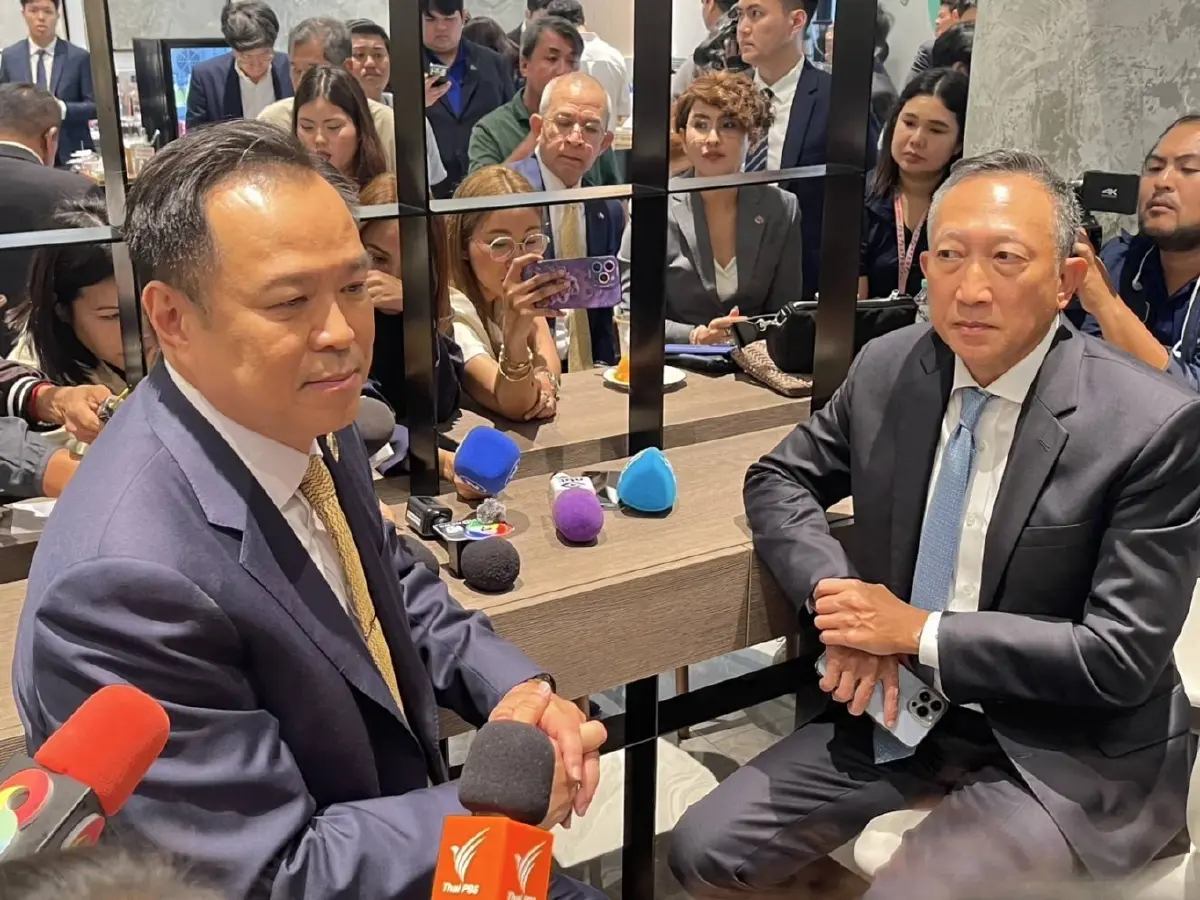
Thailand's Deputy Finance Minister was appointed to investigate a criminal network—the same network that paid his wife $3 million in cryptocurrency.
Welcome to Whale Hunting, where we follow the money from Southeast Asian scam centers to Manhattan penthouses, exposing the criminal networks that cost Americans billions each year.
On Monday, Thai Prime Minister Anutin Charnvirakul appointed Deputy Finance Minister Vorapak Tanyawong to a special government committee investigating Chinese-Cambodian criminal networks. There's just one problem: those same networks allegedly paid Vorapak's wife $3 million in cryptocurrency this year.
A Whale Hunting investigation has uncovered signed Singapore corporate filings showing the payment came directly from Benjamin Mauerberger's criminal network—the very network Vorapak is now tasked with investigating. Through this payment and parallel transactions, Mauerberger's network secretly gained control of 52% of Thai finance company Finansia X PCL, creating an illegal pipeline between crypto and traditional banking. This isn't an isolated case of corruption. It's systematic state capture.
This investigation required months of document analysis and source cultivation. If you believe accountability journalism matters, consider upgrading to a paid subscription—or sending a one-time boost. Every contribution directly funds more reporting like this.
Have a tip? Reach us at 📩 whalehunting@projectbrazen.com 📧 projectbrazen@protonmail.com 🔒 Secure contact details here.
Tom and Bradley
Following the money from Bangkok to Manhattan
📖 Start from the beginning with our comprehensive reporter's notebook
Read the Full Story →👇 BELOW: Exclusive documents reveal:
While the U.S. and U.K. last week seized $15 billion in Bitcoin from scam operations that enslave workers and steal $10 billion annually from Americans alone, Thailand's response has been crippled by one simple fact: the criminals have already purchased the country's political protection.
The scale is staggering. Cambodia's scam centers—where enslaved workers from across the developing world are forced to hook victims on fake crypto investment schemes—generate billions in illicit proceeds. These operations, run from compounds controlled by the Prince Group and other Chinese-Cambodian entities, have become so profitable that their operators can simply buy governments.
The Mauerberger network's financial tentacles reach directly into Thailand's highest offices:

"This is clearly a slap in the face to the people. This action by Prime Minister Anutin's government is no different from helping scammer gangs escape elimination," said Rangsiman Rome, an opposition MP and chairman of the parliamentary committee on national security, who is leading a separate investigation into the criminal penetration of Thai politics.

👇 Keep reading to see the exact payment documents
The payment to Vorapak's wife wasn't a simple bribe—it was compensation for participating in the systematic takeover of Thailand's financial infrastructure.
The scheme began in 2021. Vorapak, a former JP Morgan and Deutsche Bank executive who had long been a director of Finansia's predecessor, became the public face of what investigators now know was Mauerberger's covert takeover of the company. He controlled a Singapore special purpose vehicle (SPV) that held 24% of Finansia, funded through Capital Asia Investments' "CAI Optimum Fund VCC"—a Variable Capital Company structure that Singapore introduced in 2020 specifically to compete with Cayman Islands funds.
VCCs are designed to obscure money flows and ownership. They offer flexible share capital, making it easier to move money in and out without disclosure. The Mauerberger network has used this structure repeatedly across multiple deals.
💡 KEY TAKEAWAY: Singapore's VCC fund structures offer flexible share capital that obscures money flows and ownership—letting criminals hide control while appearing legitimate.
Corporate documents obtained by investigators show Vorapak's wife, Karolaporn Seetavorarat, held shares in the CAI fund alongside Cattaliya Beevor, Mauerberger's British-Thai wife. Their names appear together on the same shareholder registers—a paper trail that would prove explosive.
The fund was collateralized by the 24% Finansia stake, meaning that in the event of a default, those shares would pass to the fund holders. This gave the appearance of legitimate financing while actually serving as a mechanism for hidden control.
In November 2024, Vorapak sold his shares in the SPV. But the real action came in January 2025. Signed share transfer documents show Karolaporn sold her stake in the credit fund—and hence her claim on Finansia shares—for exactly $2,936,462.64 in Tether (USDT) cryptocurrency. On the same documents, Cattaliya Beevor's signature authorizes her receipt of $21.15 million.
Transit wallet THgk3X... created January 8, 2025
Same period as documented Finansia share transfers
👇 Below: How KuCoin became the buyer
The buyer of these shares reveals the broader conspiracy: Beteverse Ltd., directed by Li Heng, identified as a senior KuCoin executive.
KuCoin isn't just any crypto exchange. In March 2023, U.S. authorities charged it with willfully failing to maintain an anti-money laundering program, allowing billions in illicit funds to flow through its platform. The exchange was fined $300 million by the Justice Department and effectively banned from operating in America after facilitating over $9 billion in suspicious transactions.
But in Thailand, KuCoin found a warm welcome. The company's Chinese co-founders were introduced to Mauerberger by none other than Thaksin Shinawatra himself, according to a person familiar with the matter. This introduction would lead to a web of interconnected deals.
On February 10, 2025, Thai SEC filings confirm that Cattaliya Beevor sold 81,882,600 FSX shares (9.9995% of the company) to Beteverse. Just over a month later, on March 21, additional filings show BIC Bank—controlled by Yim Leak, whose father was Cambodia's deputy PM—sold another 81,880,000 shares (9.9991%) to Rapidfire Technologies Ltd., another obscure offshore entity.
The pattern was always the same: shares would be accumulated, then quickly flipped to KuCoin-connected entities.
Through these and other hidden transactions, the Mauerberger network and KuCoin assembled their 52% stake in Finansia—never properly disclosed to Thailand's Securities & Exchange Commission. Mauerberger's ex-wife continued to hold 8%, giving the combined network a controlling stake.
The Thai SEC and Stock Exchange of Thailand (SET) have since questioned FSX management about these unusual trades. Singapore's Monetary Authority is reportedly reviewing the CAI fund transactions. But the damage is done.
Earlier this year, KuCoin launched a local Thai crypto exchange in which the Mauerberger network took a stake via another VCC managed by Capital Asia Investments in Singapore. The control of Finansia, which held a digital asset license, gave the network something invaluable: a regulated, licensed gateway to move illicit funds between crypto and traditional finance under the cover of Thailand's crypto-friendly policies.
George Tan, the Singaporean co-founder of CAI who acts as Mauerberger's representative on multiple companies, serves as director of the local exchange as well as Big Touch 3 Ltd. and numerous other Thai companies backed by the network. Henry Chen, a KuCoin global employee appointed to KuCoin Thailand's board, told employees that Thaksin—whom he referred to as "Dr. T"—would ensure the company flourished.
This alleged political support manifested in concrete ways. Paetogtarn Shinawatra's decision to make KuCoin the first global crypto exchange to support Thailand's tokenized government bonds gave the criminal network a veneer of official legitimacy even as authorities in other countries were pursuing them.
The money flowing through these complex structures has a dark origin. U.S. Homeland Security Investigations has launched a criminal probe into the Mauerberger network, and a new bipartisan bill in the U.S. House of Representatives specifically names Mauerberger and Yim Leak as targets for sanctions.
According to investigations, Mauerberger and Yim Leak allegedly moved hundreds of millions of dollars originating from a U.K.-sanctioned Chinese-Cambodian business involved in scam centers and other illegal activities. They utilized BIC Bank in Cambodia to launder funds derived from scam centers, casinos, and other illicit businesses—all controlled by Chinese-owned entities already under international sanctions. (Vorapak Tanyawong was an adviser to BIC Group's board. He told Thai media he advised Yim Leak on the establishment of BIC Bank in Cambodia but denied involvement in 'dark money' syndicates. He didn't respond to our questions.)
The scam centers are industrial in scale. Compounds across Cambodia, Myanmar, and Laos hold thousands of workers—many trafficked from other countries—who are forced to run "pig butchering" scams. Victims, primarily in the U.S. and Europe, are groomed over weeks or months before being convinced to invest in fake cryptocurrency platforms. The FBI estimates these operations cost Americans alone $10 billion annually.
The proceeds flow through a labyrinth of companies and cryptocurrencies before emerging "clean" in places like Singapore and Thailand. The Finansia acquisition gave the network a crucial piece of infrastructure: a licensed financial institution that could bridge the gap between the crypto and traditional banking worlds.
Under intense U.S. pressure following the seizure of $15 billion in Bitcoin connected to these operations, Prime Minister Anutin has repeatedly declared the crackdown on transnational scam syndicates and cybercrime a top government priority.
Yet his actions tell a different story.
By appointing Vorapak—whose family directly profited from the criminal network—to investigate that same network, Anutin reveals the depth of Thailand's problem. This isn't incompetence or oversight. This is what happens when criminals don't just bribe officials but systematically purchase entire power structures.
The opposition has been scathing. Rangsiman Rome's parliamentary committee has publicly criticized the "pace and sincerity" of the government's crackdown, pointing to the deep-seated connections between Thai politicians and foreign criminal networks as the root cause of inaction.
International pressure is mounting. The U.S. Treasury has specifically highlighted Thailand as a jurisdiction of concern for cryptocurrency-related money laundering. The Financial Action Task Force has raised questions about Thailand's commitment to combating money laundering. And now, with documentary evidence of payments to the family of a sitting Deputy Finance Minister, Thailand's reputation as a financial center is at stake.
The criminals didn't just infiltrate Thailand. They bought it.
As Thailand announces committees and task forces, establishes working groups and inter-agency cooperation frameworks, the fundamental question remains: How can a government investigate criminals when those criminals are paying the investigators?
The answer, as Monday's appointment definitively shows, is that it can't.
New to this investigation? Start here:
→ Reporter's Notebook: The two-year hunt for a $1.5B scam empire
→ The Homeland Security Investigation: Why the U.S. is involved
→ Congress Fights Back: The sanctions bill targeting these fixers
Got a question or a tip for us? Get in touch at whalehunting@projectbrazen.com. You can also contact us securely here.
You can also follow Whale Hunting on Instagram, Threads and on X (Twitter). To chat with fellow Whale Hunters and stay in touch with Bradley and Tom, join our Discord server.
For unlimited access to Whale Hunting’s investigative reporting, consider signing up for a paid subscription. You’ll get special editions of the newsletter and the Weekender, as well as premium podcast access and discounted merch.
Enjoying Whale Hunting but not ready to subscribe? Show your support by leaving a tip (via credit/debit card or crypto) instead.
 Related Posts