
The Target List: Washington Steps Up Drive Against Mauerberger Network and Thai Elites
by Tom Wright
/

Behind the yachts and private jets of the $1.5 billion Mauerberger network, a vast criminal enterprise traffics foreign nationals into Cambodian scam centers to steal billions from US victims.
In our series so far on the $1.5 billion Chinese-Cambodian money network, we’ve focused on how the criminals, fronted by South African Benjamin Mauerberger, took dirty cash and bought yachts, private planes and $20 million apartments in New York – all under the cover of former Thai Prime Minister Thaksin Shinawatra.
Now we’re going deep inside Cambodia, one of the most corrupt countries on earth, to show how this network generates billions of dollars from crime to fund the extravagant lifestyles of Mauerberger & co. Behind the yachts and the planes and paid-for politicians, there are real victims. In this case, it’s the foreign nationals trafficked into Cambodia’s notorious scam industry, and the people around the world they are forced to target at-scale.
The Cambodian landscape is dotted with fortified compounds – run mostly by Chinese gangsters, with heavy protection from members of the ruling elite and the formal institutions they control – where people from more than 70 countries (according to the U.S. Department of State) are compelled to scam victims from an even wider range of nations. These “pig-butchering scams” cost Americans at least $10 billion annually, the U.S. Treasury estimates – likely the leading form of financial crime hitting the United States today. In this installment, we’re joined by a guest co-author (transnational crime expert and Harvard Fellow, Jacob Sims) who will help us show how this criminalized national ecosystem connects back to the Mauerberger network.
This story is free to read with your email. This kind of journalism, however, is costly to produce.
If you believe accountability journalism matters, please upgrade to a paid subscription or send a one-time boost. Every contribution directly funds more investigations like this one.
Tom and Bradley
Important: To continue this work, to pull back the curtain on these hidden empires and expose the looming threat, we need your support. Our journalism is a volunteer effort fueled by the belief that the truth should not be a luxury. If you believe in our mission, please upgrade to a paid subscription or send a customized boost of support. Every contribution helps us dedicate more resources to exposing these hidden networks of power and wealth. This series is free to read for anyone who signs up with their email, but we are asking for support from people who have the means to do so.

Check out the Brazen Whale Hunting Collection. Subscribers will see a 20% discount code right after the jump.
For the wider investigation, read our guide to Benjamin Mauerberger, the records and the responses.
| Story | Link |
|---|---|
| Rich List: The Fixer, the Jet, and Thaksin's Shadow Wealth | Read → |
| Thaksin's Fixer and a Cambodian Empire's Push to Control Thai Energy | Read → |
| Exposed: The $1.5B Money Laundering Network Behind Thailand's Shinawatra Dynasty | Read → |
| Indicted Crypto Firm KuCoin and a Thaksin Ally Allegedly Built a Money Laundering Network Across Southeast Asia | Read → |
| Breaking: KuCoin Tries to Silence Our Investigation with Legal Threats | Read → |
| The Super Yachts of a Global Criminal | Read → |
The Network
Chinese Partners
Political Figures
Financial Operators
Key Companies
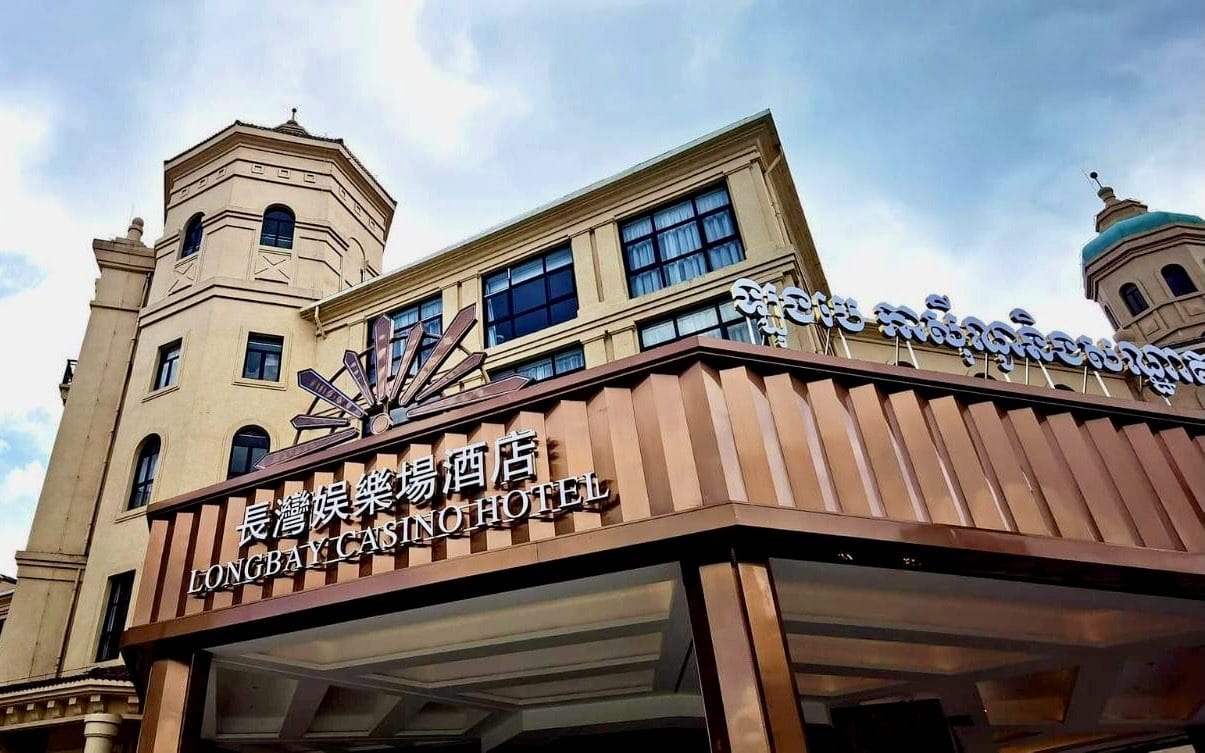
Kris, a 31-year-old customer service rep from the Philippines, realized something was very wrong as the van hurtled past the outskirts of Phnom Penh and into Cambodia’s jungled interior. The nerve-wracking six-hour journey ended at Long Bay resort where he discovered the job he’d applied for on a Facebook forum wasn’t what it seemed. Instead of helping clients with a new software package, Kris was forced to chat up Westerners on social media and slowly lure them into investing in rigged – or wholly fabricated – cryptocurrencies.
Kris didn’t know it, but he was playing a tiny role at the bottom of the Mauerberger network – a sprawling criminal ecosystem stretching from China to Thailand and Singapore, all the way into luxury yachts, planes and Manhattan penthouses. The explicit connection between Kris and the $1.5 billion Mauerberger network comes via Zhengheng, a Cambodian company founded by a Chinese national that operates the Long Bay tourism, residential, and office development. Despite private offers of bribes and public legal threats protesting its innocence, Zhengheng has long been linked to Cambodia’s scam economy, due to the stream of reports of human trafficking, torture, and extrajudicial killings emerging from its Long Bay properties.
For instance, in 2022, the Voice of Democracy – an independent paper later shut down by authorities for its fearless reporting on Cambodia’s state-abetted scam industry – revealed how a Taiwanese national was imprisoned at Long Bay. The reporting showed how he was forced to pay for calls home via a special app, which listed a Zhengheng director’s assistant as a contact.
On its now-defunct website, Zhengheng (founded in 2017) listed BIC Bank as a related business – and BIC, as we’ve previously reported, is owned by Yim Leak, Benjamin Mauerberger’s secret Cambodian partner.

Yim Leak is as connected as they come in Cambodia. His father is a former deputy prime minister, and his sister is married to Prime Minister Hun Manet's brother. For over four decades, the Hun family and their web of intermarried power brokers has controlled the ruling Cambodian People’s Party (CPP). Scholars suggest that the CPP retains its unpopular grip on domestic politics through an elite patronage network that serves to secure the loyalty of Cambodia’s military and law enforcement apparatus. Going all the way back to the beginning of CPP rule over 40 years ago, this network has been primarily fueled by an array of predatory, extractive, and outright illicit industries—logging, land grabs, gambling, and now…cyber-enabled crime. These high-margin illicit sectors generate both rents for key elites and off-the-books resources to suppress rivals and buy loyalty.
By the late 2010s, around the time Yim Leak founded BIC Bank, Cambodia’s most lucrative economic opportunities clustered around a massive influx of gray and illicit Chinese capital, driven by Belt and Road projects, Beijing’s crackdown on underground casinos at home, and Cambodia’s notoriously corrupted naturalization process, among other factors.
It is against this bleak political-economic backdrop that Benjamin Mauerberger boasted to business partners in Thailand that Yim Leak was being granted land at favorable rates in Cambodia and then teaming up with Chinese investors, who would provide capital and expertise. Their cut, he said, was 20 percent.

Yim Leak and Mauerberger, a former boiler-room operator and money laundering expert (a typical bagman for Southeast Asian elites), began by selling island land to mainland Chinese investors – an easy way to launder money. The 489 hectares granted to U. Property Management, where Yim Leak and “Ben Smith” (Mauerberger’s alias) were directors, generated $400 million in sales, Mauerberger told his partners.
But that was peanuts compared to the ambitious 36,000-hectare coastal concession awarded to the Chinese state-owned entity Union Development Group (sanctioned by the U.S. Treasury in 2020) for a sprawling tourism, business, and industrial complex. Long Bay was to be its centerpiece. Zhengheng, founded by China-born Deng Pibing (now also a Cambodian citizen), became a key developer and brought in Yim Leak’s BIC Bank and BIC Security as partners.
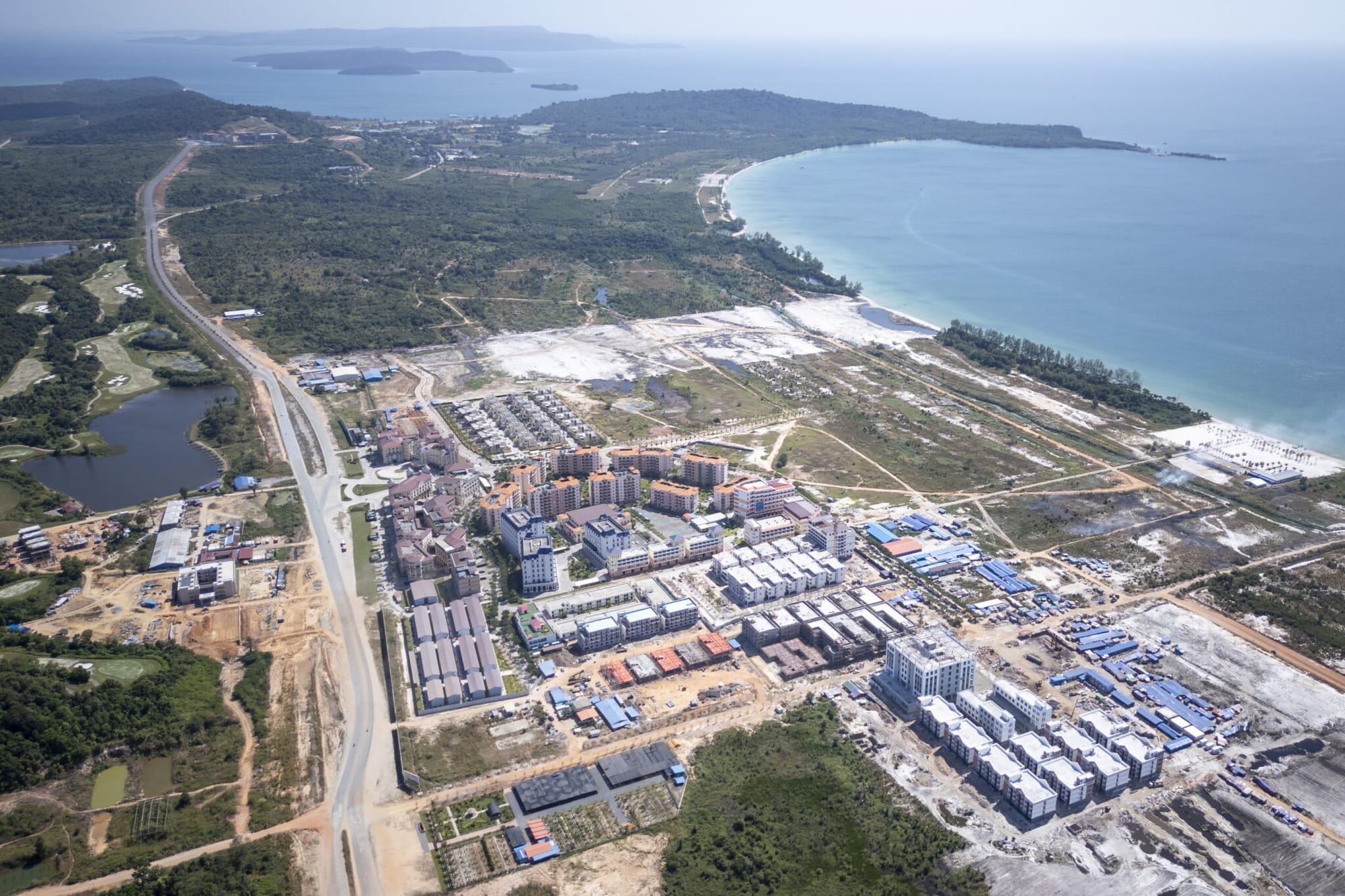
Long Bay, however, has been a failure – at least from a tourism standpoint – with many buildings standing incomplete and empty and construction still only partially complete. Instead, online scam operations have proliferated with syndicates luring foreign workers with promises of white-collar jobs only to hold them as slaves until they repay fabricated debts. Local observers estimate Long Bay’s scam workforce may exceed 2,000. Using a rough but conservative UN and NGO estimating approach, the compound could generate more than a quarter billion dollars annually in scam revenue alone – all on the backs of people like Kris.
The UN and the U.S. State Department estimate that 100,000–150,000 people remain trapped in similar conditions across Cambodia. The incentive is clear: scam centers now generate between $12.5 and $19 billion annually, roughly half the country’s GDP. And Yim Leak’s links to the industry are more the norm than the exception amongst Cambodian elites. Most of the major compounds are directly linked to ruling party senators, cabinet-level ministers, leading oligarchs, and criminalized corporations like Prince Holding Group and Huione Group, led by formal advisers to and even family members of the Prime Minister. This cadre of elites has come to count on the reliable support of the country’s formal institutions – for security, for propaganda, for sanctions evasion, and everything in between.
Though their refutations have been loud and litigious, a combination of unassailable investigative reporting, high volumes of first-hand witness testimony, and, notably, the government’s own corporate and naturalization records leave little doubt.
Recent research has also linked Cambodian scam compounds (including Long Bay resort) to the ruthless sextortion schemes that now plague American teens (predictably rejected as “baseless” within hours of release by Cambodia’s National Committee to Counter Trafficking). Moreover, UNODC warns these illicit online operations are deeply entwined with drug smuggling, wildlife trafficking, and money laundering. Taken together, these gambling-adjacent illicit financial flows constitute the most lucrative industry in Cambodia’s history—and potentially the most significant economic engine of the entire Mekong sub-region.

Though the specifics remain murky, BIC Bank’s partnership with Zhengheng certainly appears to have been fruitful for Yim Leak and Mauerberger. As we have previously reported, Mauerberger bought a Gulfstream G550 private jet for his Cambodian partner. Yim Leak and his wife, herself an heiress to a Thai construction empire, posted photos of vacations from around the world. In one photo, Leak wears a $2 million Richard Mille Tourbillon Skull watch, while his wife is dressed in Louis Vuitton pajamas.

Leak also acquired a $20 million villa in Phuket and a penthouse in Bangkok’s Aman apartments, where Mauerberger owned a unit as well—alongside his Manhattan pad on “Billionaire’s Row.” To ensure the continued political protection necessary to keep the party going, Mauerberger lavished gifts on VIPs, including a $60 million Bombardier Global G7500 for Thaksin Shinawatra.

As the dirty money flowed out of Cambodia, Yim Leak and Mauerberger needed a way to launder funds into the global financial system. They set up a financial front company in Singapore, a regional financial hub, and secretly bought up a stake in Finansia X Plc., a Thai finance company, which it later sold to KuCoin, a crypto exchange (on Thursday KuCoin was fined $14 million by Canada's money-laundering agency, and $300 million in 2024 by the U.S. government). With this infrastructure in place, the Mauerberger network could launder huge amounts of money.
And it is worth noting that the development of Long Bay is likely just a fraction of their portfolio. Gambling, too, has become a huge source of wealth for Cambodia – and Yim Leak set about building an empire. Today he is a director of the Queenco Casino in Sihanoukville, according to Cambodia’s 2021 corporate registers. A lottery tied to Yim Leak, A.L.L. Golden Luck, lists Sathit Limpongpan, a senior official in Thailand’s Ministry of Finance, as a former director (he's also a former chairman of BIC Bank)…with strong ties back to Thaksin.

When Thaksin returned from exile in 2023, one of his first proposals was to legalize gambling in Thailand. His daughter, Prime Minister Paetongtarn Shinawatra, hosted Las Vegas casino CEOs in Bangkok. At one meeting, MGM Resorts International CEO William J. Hornbuckle was reportedly surprised to see Benjamin Mauerberger at the table. The South African fixer had bought Thaksin gifts like the Bombardier jet, but also cultivated influence through his deep knowledge of Cambodia’s casino industry.
Now, that protection appears to be collapsing. Thaksin’s recent jailing for corruption—coming a month after his daughter’s ouster by Thailand’s constitutional court—has stripped Yim Leak and Mauerberger of their most powerful (or at least visible) Thai political shield. Sources suggest that Leak has quietly flown the contents of his Bangkok penthouse back to Cambodia. Mauerberger has been spotted in Bangkok and Dubai but is keeping a low profile, as U.S. and Singaporean authorities close in on the assets that financed this global web of crime.
Thaksin’s push to expand gambling in Thailand may have left him politically exposed just as the scam industry was escalating into a national security liability for Thailand. Some analysts now suggest that Thaksin’s downfall cannot be separated from the scam economy itself. Indeed, it is hard to overstate how much Thai gambling legalization would have encroached on the Hun family’s principal economic engine – perhaps partially explaining Hun Sen’s direct role in accelerating the Shinawatra’s downfall back in July.
And, as Foreign Policy recently reported, pig-butchering scams and the fortified compounds along the Thai-Cambodian border have become flashpoints for regional conflict, feeding corruption, human trafficking, and money laundering on both sides. Whatever the precise mix of factors, it is apparent that the same criminal economy that enriched Thaksin’s circle may also have hastened his undoing.
This unraveling of the Shinawatra dynasty is a reminder that criminal economies need not collapse under the weight of their own abuses. Rather, they can easily persist, so long as political patrons find them useful. In Cambodia, as across the Mekong, scams, casinos, and laundered billions have flourished not in the shadows but in plain sight, protected by elites who profit from them at a scale with few historical precedents. Accordingly, what we are witnessing now should not be seen merely as “justice finally catching up with” Mauerberger and Yim Leak, but the more precarious reality that when political winds shift, even the most extravagant empires of corruption can be left suddenly exposed to rare windows for elite accountability.
Got a question or a tip for us? Get in touch at whalehunting@projectbrazen.com. You can also contact us securely here.
You can also follow Whale Hunting on Instagram, Threads and on X (Twitter). To chat with fellow Whale Hunters and stay in touch with Bradley and Tom, join our Discord server.
For unlimited access to Whale Hunting’s investigative reporting, consider signing up for a paid subscription. You’ll get special editions of the newsletter and the Weekender, as well as premium podcast access and discounted merch.
Enjoying Whale Hunting but not ready to subscribe? Show your support by leaving a tip (via credit/debit card or crypto) instead.
 Related Posts