Happy 4th of July: Jho Low's Last Bet
by Bradley Hope
/
Harry Sargeant III built a fortune where sanctions, political access and private opportunity overlapped. Then Washington revoked the licence behind his Venezuelan asphalt monopoly and it all came tumbling down.
Welcome to Whale Hunting, where we follow the money behind some of the world’s most brazen financial networks and reveal the people who enable them.
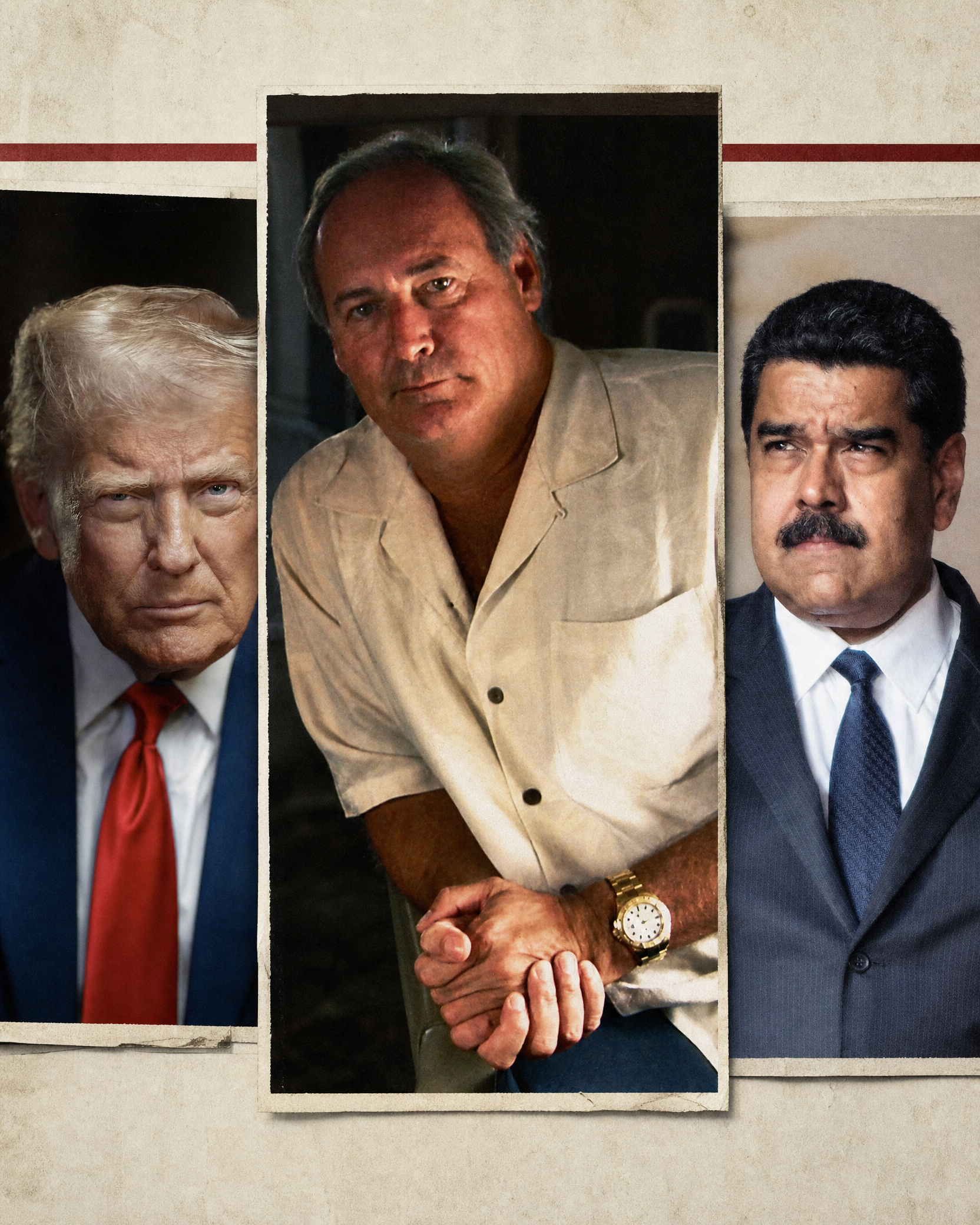
For nearly forty years, Harry Sargeant III has prospered where business depends on political persuasion. The former Marine pilot became a major Republican fundraiser and a regular golfer at Mar-a-Lago. In Venezuela, Nicolás Maduro called him abuelo, grandfather.
Sargeant’s great talent was finding the letter, license or relationship that opened a market his competitors could not enter. A permit from Jordan gave his company control of a vital fuel route into Iraq during the war. Two decades later, a private Treasury license made another Sargeant company the only American buyer allowed to purchase Venezuelan asphalt.
That kind of access lasts only as long as the person who granted it wants it to. In February 2026, Trump posted that Sargeant had “no authority, in any way, shape, or form” to act for the United States. By then Treasury had already taken the asphalt license away.
From the outside, it looked like the spectacular political fall of a businessman who had finally pushed his access too far.
But Whale Hunting has uncovered something more serious. Internal Venezuelan bank records, ledgers from PDVSA, the state oil company, shipping documents and private messages show what happened inside Sargeant’s asphalt trade as Washington closed it down.
Hours before a Treasury payment deadline expired, two state-bank certificates said his company had paid more than $43 million in cash. People familiar with the transactions in the United States and Venezuela say the money never arrived and the certificates were manufactured so that asphalt could continue moving after the lucrative license was revoked.
Federal investigators are examining the dealings, according to people familiar with the matter. The records do not independently prove that the money failed to move, and they do not establish that Sargeant ordered, knew of or presented the certificates. No charge arising from the payment has been publicly announced.
But they show the purported payment being turned into credit for future shipments, then applied as cargoes continued leaving Venezuela. They also lead to a Venezuelan contractor that later surfaced in another proposed asphalt trade with Sargeant’s company, this one carrying a theoretical gross spread approaching $100 million.
Our reporting raises a graver question: did his company try to preserve an exclusive trade with manufactured bank papers after Washington withdrew the permission on which the monopoly depended?
Three weeks after Sargeant signed away his stake in the Venezuelan oil company he had co-founded, Trump announced a deal covering seventeen Venezuelan oilfields and more than 65 billion barrels of reserves. The intended operator, according to reports, is that same company, now controlled by his former partner, Alejandro Betancourt. One man’s exit from Venezuela was the other’s entry into the largest oil arrangement Washington had put on the table.
That contrast matters because Trump’s political world can accommodate wealthy dealmakers with complicated histories when they remain useful. What Trump has little patience for is someone appearing to trade on his name or turn proximity to him into authority of their own. His reversal carries a warning: access to Trump can create extraordinary value, and Trump alone decides how long it lasts.
Get the full story—free with your email.
This story is open to all and our work is available for free to anyone who signs up with their e-mail. But investigations like this aren’t cheap. If you believe accountability journalism matters, consider upgrading to a paid subscription – or sending a one-time boost. Every contribution directly funds more reporting like this.
Have a tip? Reach us at:
📩 whalehunting@projectbrazen.com
📧 projectbrazen@protonmail.com
🔒 Secure contact details here.
In November 2017, Sargeant flew to Venezuela to see about buying oil.
The visit began badly. His plane was directed to a special hangar in Caracas and surrounded by soldiers. The next day, a small convoy of SUVs took him to a house inside Fuerte Tiuna, the capital’s sprawling military base. Officials showed him a room filled with live snakes, some venomous, displayed behind glass.
Sargeant thought he had come to meet a PDVSA official he knew. Instead, Nicolás Maduro was waiting.
Maduro was “friendly but serious,” Sargeant later recalled. Through an interpreter, the socialist president asked why American companies were no longer investing in Venezuela and mused that his ruined economy could reinvent itself as China had. A few months later, a Delaware company in which Sargeant was a shareholder began negotiating a deal to rehabilitate three Venezuelan oilfields in return for almost half the revenue.
In February 2019, Sargeant received a Reuters reporter in the wood-paneled cigar room of his mansion in Gulf Stream, a Florida enclave down the coast from Mar-a-Lago. He was 61, and untroubled by doing business with a government his own party wanted gone.
“We like high-risk places,” he said.
He meant it. Sargeant graduated from Florida State in 1979 with a business degree, became a Marine fighter pilot and served for eleven years, including a stint at Top Gun, E&E News later reported. He then flew commercial routes for Delta.
He left the airline to run the small shipping business his father, a retired naval officer, had started in 1983. Sargeant found his niche in asphalt, an unglamorous commodity that is difficult to store, harder to transport and indispensable when governments decide to build. The company introduced ISO bitumen containers to the international market, accumulated asphalt tankers, barges and bulk containers, and converted the Asphalt Commander into the world’s largest asphalt tanker at the time, according to its company history. Sargeant named another tanker for Florida State’s Seminoles.
Sargeant’s dealings in Venezuela dated to the late 1980s. At home he became a familiar figure in the political life around Mar-a-Lago. His wife gave $285,000 to the Trump Victory Fund in 2019 and 2020. Sargeant often golfed with Trump, people familiar with the relationship say. Maduro called him abuelo, grandfather.
The nickname suggested familiarity, but also durability. Sargeant had outlasted political movements, investigations, lawsuits and changes of government. He did not present himself as an ideologue. In the same interview, with Trump and Marco Rubio pressing to remove Maduro, Sargeant said who governed Venezuela was not his concern.
“Our business is with PDVSA, the institution,” he told Reuters. “We are not into the politics of the situation.”
What made Sargeant properly rich was a letter from the government of Jordan.
In 2004, the Pentagon was struggling to supply American forces in Iraq. The contractor handling fuel deliveries was failing, and the southern convoy route from Kuwait to Baghdad had become a killing ground. The Defense Department turned to a northern corridor: fuel would arrive through the Jordanian port of Aqaba and cross into Iraq through Anbar province.
Six companies qualified to compete for the work. Only one could use the route.
Jordanian Prime Minister Faisal al-Fayez signed a letter allowing Sargeant’s company, International Oil Trading Company, to carry fuel through Jordan. Comparable letters would not be issued to the other bidders, the country’s Ministry of Energy later told the Pentagon. The solicitation was American; the bottleneck was Jordanian.
His company went on to receive more than $2.66 billion in Pentagon awards, including $601 million in 2007. The advantage became visible in the final bids. With the Jordanian route closed to the other qualified companies, Sargeant’s business raised its price while competitors lowered theirs. The company bid $2.10 a gallon against a government-constructed price of $1.7390.
The exclusive route had allowed the company to charge between $123.8 million and $204.9 million above a reasonable price, Defense Department auditors later estimated. Their conclusion was more qualified than some of the headlines: it was difficult to determine whether the company had engaged in war profiteering, the auditors wrote. The arrangement was an effective monopoly, according to the House Oversight Committee’s then-chairman, Henry Waxman. Sargeant rejected the allegations.
The later record cut the other way. No fraud vulnerabilities were found in a subsequent Pentagon review, and in 2018 the United States government paid Sargeant’s company $40 million to settle a related dispute. The settlement was a vindication against politically motivated fraud claims, he said.
The Jordan business also produced a rupture with the man whose royal access had helped open it. Mohammad Al-Saleh, who was married to King Abdullah II’s half-sister, claimed he had been cut out of the venture and sued. At trial he alleged that $50 million in graft had been directed to the highest levels of the Jordanian government. That was an allegation, not a finding by the court.
In 2011, a Palm Beach County jury ordered Sargeant to pay Al-Saleh $28.8 million. The verdict survived appeal. Sargeant did not immediately pay, and the collection effort ran for five years across several jurisdictions.
The chase involved “phalanxes of lawyers and multi-jurisdictional structuring,” sheriffs raiding houses, secret safety-deposit boxes in high-end London hotels and planes on private airstrips, according to a later shareholder account by Burford Capital, the litigation funder that financed enforcement. Burford was an adversary describing a successful investment in its annual report, not a prosecutor making a criminal case, and the passage referred only to “the defendant.” It did not name Sargeant.
Burford spent about $10 million enforcing the judgment and booked a net profit of $12.1 million, it told shareholders. In October 2016, Sargeant and Al-Saleh settled during court-ordered mediation. Al-Saleh received more than $30 million.
While the Iraq litigation unfolded, Sargeant made himself useful in Florida politics. He had known Charlie Crist since their fraternity days at Florida State. When Crist became governor in 2006, he appointed Sargeant finance chairman of the state Republican Party. Sargeant, his wife and related companies became substantial Republican donors.
Florida politics also drew him into the Ukraine affair that produced Trump’s first impeachment.
In 2019, Rudy Giuliani’s associates Lev Parnas and Igor Fruman were working in Ukraine to gather damaging material on the Bidens and to remove the American ambassador, Marie Yovanovitch. Sargeant loaned Parnas money and paid for travel by both men. The record of their exchanges survived because the FBI extracted Parnas’s iPhone and the House Judiciary Committee published the material.
At 3:05 on the morning of March 25, Parnas sent Sargeant two words about Yovanovitch:
“She’s gone”
Sixteen minutes later, Sargeant replied:
“AWESOME!!!”
A month later, Sargeant complained about the cost: “Just getting expensive flying u guys everywhere LEV.”
Sargeant was not accused of participating in the donation scheme that later put Parnas in legal jeopardy, and he was not accused of wrongdoing in the impeachment proceedings. There was no plan to remove Yovanovitch, Sargeant had never traveled to Ukraine to meet Parnas or Fruman, and he had no business interests there, his lawyer Chris Kise said. Sargeant simply liked Parnas, a “colorful and funny acquaintance” who appeared desperate and short of money, Kise said.
None of this gave Sargeant official standing. But two men running errands for the president’s lawyer took his money, texted him the news at three in the morning and expected him to keep paying for the flights.
In Venezuela, the opportunity was larger. Sargeant and Kise acknowledged in 2019 and 2020 that back channels to Maduro had been opened to encourage him to step aside. The earlier oil-field rehabilitation proposal died because sanctions made it impossible. In February 2020, Kise registered to lobby for the Venezuelan government in an effort to lift sanctions; Republican objections followed, and the contract ended within days.
By early 2025, Sargeant had again become a bridge. He helped broker a Caracas meeting between Maduro and Richard Grenell, Trump’s special envoy, covering American prisoners, migrant deportations and Chevron’s license. Members of his team had spoken with American officials about Venezuela’s oil sector, and he encouraged the administration to deal with Delcy Rodríguez, Maduro’s vice president, rather than opposition leader María Corina Machado, Sargeant later told Reuters. He never discussed Venezuelan oil with Trump and was not formally advising the administration, he said.
At the same time, Sargeant was trying to protect a narrower prize: the private Treasury license behind Global Oil Terminals’ asphalt trade.
He hired Aaron Schock, the former Illinois congressman, for a $100,000 lump sum. The engagement was strategic consulting rather than lobbying and was not an effort to lift sanctions, Kise said. There was no registration under the Foreign Agents Registration Act or the Lobbying Disclosure Act, Politico found.
The money behind the effort came from five companies and investors with exposure to Venezuela. Chevron promised $100,000. Curaçao Refinery Utilities put up $200,000. Fidera and Mangart Capital Management each contributed $50,000. Another $80,000 was routed through a Taiwanese company called Smart Property Solutions.
Its political aim was to strengthen the accommodationist channel around Grenell against the harder line associated with Rubio and Mauricio Claver-Carone, a former Trump special envoy who remained an unofficial adviser on Venezuela. That distinction ran straight through Sargeant’s business: a license preserved the asphalt trade; maximum pressure would end it.
The funders did not all want the same thing, but each had a commercial reason to prefer a softer American policy. Chevron needed its own license. Fidera had joined a committee representing holders of defaulted Venezuelan government debt. Mangart had been buying those bonds at distressed prices. Curaçao Refinery Utilities was part of a refinery chain commercially linked to a Sargeant company. None of that proves the funders acted as a bloc or expected a particular return.
The Curaçao contribution came from a government-owned company. The government of Curaçao held 100 percent of Refinería di Kòrsou, which in turn owned Curaçao Refinery Utilities, according to an ownership chain described by Venezuela’s lawyers in an ICC arbitration filing later lodged in federal court. Whale Hunting asked the refinery and the island government whether anyone had approved the payment. Neither had answered by publication.
The campaign was organized through a Signal group created by the distressed-debt investor Hans Humes. In the final week of March 2025, as licenses were being canceled, a screenshot of one call agenda reduced the Venezuelan objective to one line: “VZ: funds, message.” Sargeant wrote to the secretaries of State and Treasury urging a softer line on Caracas.
Federal investigators began examining whether the effort crossed lobbying or foreign-influence laws, Politico reported. Schock performed legitimate consulting work and Sargeant was not under FBI investigation, Kise said.
In May 2024, Treasury granted Global Oil Terminals a specific license to buy Venezuelan asphalt. The license was not public. It was due to last two years and made Sargeant’s company the only American buyer authorized to conduct the trade.
Over eleven months, Global Oil Terminals bought 41 cargoes containing about 1.53 million metric tons of asphalt products, internal PDVSA records reviewed by Whale Hunting show. PDVSA valued the trade at roughly $193 million.
Sargeant was returning to a business that had already left scars. PDVSA had forced a Sargeant company out of Venezuelan asphalt in 2005, Sargeant’s company said; it once owed the state oil producer a $52 million judgment, according to court records.
The family business also had a criminal record in Venezuela. In 2020, Sargeant Marine Inc. pleaded guilty to an eight-year conspiracy to violate the Foreign Corrupt Practices Act and agreed to pay a $16.6 million fine. Sargeant Marine bribed officials in Brazil, Venezuela and Ecuador to win asphalt contracts, the company admitted.
In Venezuela, the company paid four PDVSA officials for non-public information and help steering purchase contracts to a company nominee, it admitted. The code word in the messages was “Chocolates.” Six individuals pleaded guilty in the wider investigation, including Daniel Sargeant, Harry’s brother and a senior executive.
Harry Sargeant III was not charged in that case, and the corporate plea and his brother’s conviction do not establish that he participated in the conduct.
Venezuela’s isolation shaped how the money moved. More than $77 million was recorded in Tether, the dollar-linked cryptocurrency. Another $79 million passed through Banco de Venezuela. About $36 million moved through BANDES, Venezuela’s state development bank.
The crypto payments need some context. Stablecoin settlement is common in commodity trading, and Venezuela had practical reasons to avoid correspondent banks reluctant to handle PDVSA funds. A payment in Tether is not evidence of illegality. Twenty-three entries totaling $77,453,890.57 were marked as received in USDT, Tether’s ticker; nineteen named no vessel. The crypto payments stopped on January 14, 2025. Nineteen conventional payments followed through April 1, every one tied to a vessel. The records do not explain the change.
Then Washington changed policy.
On March 28, Treasury revoked the Global Oil Terminals license as part of a wider cancellation of energy authorizations involving Venezuela. Transactions “ordinarily incident and necessary” to a wind-down were allowed under the revocation notice. Financial transactions had to end by April 2. Cargo operations could continue until May 27 for product already purchased.
The two deadlines left a gap. Asphalt paid for before April 2 could still be loaded for another eight weeks.
At 11:58 a.m. on April 1, BANDES certified a $27 million cash payment from Global Oil Terminals. At 12:39 p.m., it certified another for $16,226,288.
Both documents were addressed to PDVSA’s vice president of finance, signed by the same two bank officers and sealed. Both identified the product as asphalt cement. Neither identified a vessel. The ship was “to be determined.”
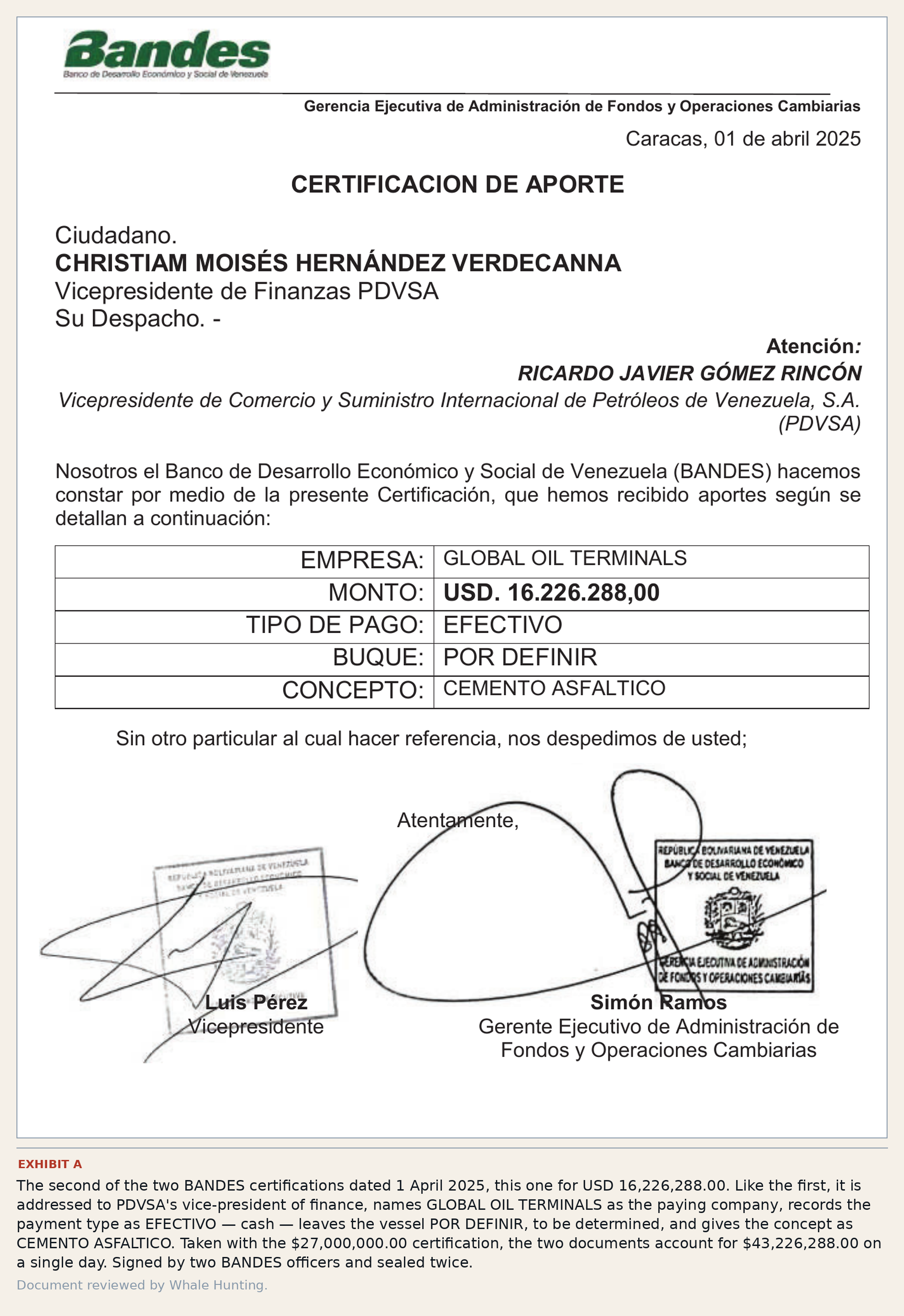
Global Oil Terminals held credit available to settle upcoming dispatches, a PDVSA memorandum issued the same day said. A second internal breakdown allocated credit to twelve future cargoes. The collections ledger entered a cluster of April 1 payments that totaled $43,226,288, matching the BANDES certificates.
There was no payment, people familiar with the transactions say. The certificates were manufactured to create a prepayment inside Treasury’s window, allowing cargoes to keep moving after the license ended, according to their account.
Asphalt continued loading after the payment cutoff, the shipping records show. Bills of lading run from April 3 through May 21. Six of eight shipment values match April 1 ledger entries exactly. PDVSA applied the purported credit against physical cargoes leaving Venezuela. What the papers do not show is whether the money ever arrived.
There are ordinary explanations for parts of this. Prepayment for an unnamed vessel is standard commodity practice. Treasury did not order Sargeant to stop all activity on March 28; it instructed him to settle remaining obligations and gave him until April 2 to do so. The last bill of lading in the records is dated May 21, six days before the cargo deadline. On the face of the calendar, the payments and shipments fall inside the wind-down.
The harder question is what was being paid for. The wind-down covered remaining debt for asphalt purchases, according to Treasury’s terms. The credit was available for upcoming dispatches, PDVSA said. The matching bills of lading run as late as fifty days after the certificates. Whether the wind-down authorized prepayment for weeks of future cargo is a legal question the documents do not answer.
The bigger gap is on the bank side. There is no Global Oil Terminals bank statement, originating transfer or wallet record, or corresponding entry showing the money arriving in a BANDES account in the records reviewed by Whale Hunting. A certification is evidence that a bank said it received funds. It is not, by itself, proof that funds moved—or that they did not.
The documents reviewed by Whale Hunting include the original license and the revocation, but not every instrument in between. The OFAC sequence indicates another license-related document was issued before the cancellation. Its terms, and the representations made to obtain it, are unknown.
Who at Global Oil Terminals ordered, knew of or presented the certificates is not established by the documents.
Sargeant was not under FBI investigation and had acted lawfully, his lawyer Chris Kise told Politico. Whale Hunting sent Kise a detailed account of the records and questions about Sargeant’s knowledge and the later cargoes. He had not responded by publication.
American investigators are examining the April transactions as part of broader federal scrutiny of Sargeant’s businesses, people familiar with the matter say. That is separate from the influence scrutiny reported by Politico. The government has not publicly announced charges arising from the payments.
The largest purported payment had an exact twin in another BANDES record from the same morning.
At 11:58 a.m., $27 million had arrived from Global Oil Terminals for Venezuelan asphalt, BANDES said.
BANDES owed $27 million to a Venezuelan contractor called Servicios Petroleros del Sur, according to a second document. The payment was described as an advance on work at the Amuay refinery, Venezuela’s largest.
The amount was identical. So were the bank, the date and the two officials signing the records.
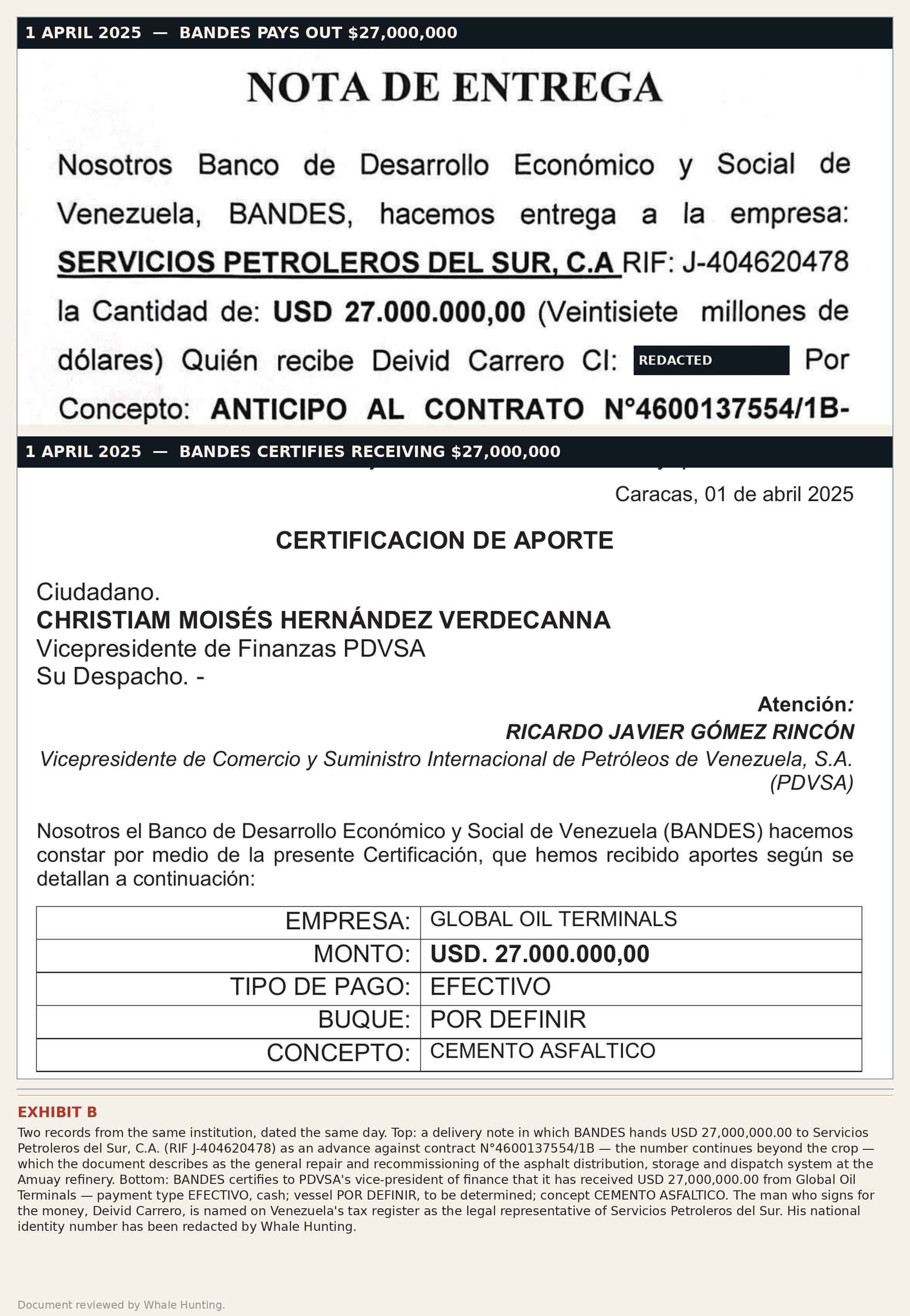
The entries were two sides of an accounting loop, people familiar with the transactions say. BANDES recorded an asset for Sargeant’s company—the supposed asphalt payment—and an obligation to the contractor without receiving the cash, according to their account. Global Oil Terminals gained credit for future cargoes. Servicios Petroleros del Sur gained a claim against the bank.
That is not stated in the documents. On their face, they record two separate transactions. Banks can receive and disburse the same amount on the same day without the money being connected, and records Whale Hunting has not seen may explain the match.
Another unexplained detail appears in the contractor’s agreement with PDVSA. Servicios Petroleros del Sur had a €164 million contract to rehabilitate asphalt storage, distribution and dispatch infrastructure at Amuay. PDVSA, not BANDES, could advance money once the contractor provided a guarantee for the full amount, the contract said. The construction term ran for 360 days from its 2024 start. The April 1 obligation appeared near the end of that period, described as an advance but equal to the largest purported Global Oil Terminals payment.
No side agreement, guarantee or instruction authorizing BANDES to make the advance appears in the records reviewed by Whale Hunting. Such records may exist.
Servicios Petroleros del Sur was a substantial contractor, with at least 64 active contracts and more than $215 million across 23 accounts, PDVSA vendor records show. Its public profile was thin for a company handling sums of that size. A PDVSA buyer-registration memorandum listed a Gmail address and a residential address, and two required registration stages were incomplete. Its obligations first appear in March 2025, less than three weeks before the paired entries, the company’s tax ledger shows. Venezuela’s tax registry lists Deivid Carrero as the company’s legal representative, director of operations and sole shareholder.
None of that proves a crime. Small contractors win substantial public work. Barter-style arrangements can route oil revenue into infrastructure. A development bank can book an incoming commodity payment and an outgoing construction advance on the same date without handling the same funds. A prepayment for an unnamed cargo can be ordinary.
What remains unexplained is the combination: the same $27 million, the same day, the same bank, the same two signatures, a cash entry for a vessel not yet chosen, and a construction advance from a bank not named in the construction contract—all on the last full day Global Oil Terminals could send money to Caracas.
On January 3, 2026, American forces captured Maduro and took him to the United States. Two days later, Delcy Rodríguez was sworn in as interim president.
On February 9, 2026, PDVSA notified its finance department of a new sale. Servicios Petroleros del Sur, the contractor at the other end of the April 1 BANDES entry, was authorized to buy up to 10.8 million barrels of asphalt cement from Amuay over twelve months. The refinery contractor now held an upstream purchase right.
The asphalt was priced at $18 below the Platts Gulf Coast benchmark, according to a separate PDVSA deal summary. Global Oil Terminals was the proposed downstream seller to Trafigura’s Singapore branch at $8.95 below the same benchmark, another summary dated February 10 said.
The difference was $9.05 a barrel. If all 10.8 million barrels authorized by PDVSA moved at those terms, the theoretical gross spread would approach $97.7 million. That is arithmetic, not realized profit. The volume that moved, the costs that intervened and any division of the economics remain unclear from the documents.
In private messages supplied to Whale Hunting, one participant described a contract “with Harry” for 10.7 million barrels through February 2027 at a margin of $10 a barrel.
“100 millones de ganancia por el contrato?” one participant asked—$100 million profit on the contract?
“Back to back sin ningun riesgo,” came the reply. Back to back, with no risk. Asked whether the intermediary had ships, the same participant answered: “Cero.”
Four different volumes appear in the records, and they are not the same deal. 10.8 million barrels was the PDVSA authorization to Servicios Petroleros del Sur. 10.7 million barrels appeared in the private broker proposal. A document later put one planned spot cargo at 200,000 barrels. The unperformed spot cargo was 190,000 barrels, Trafigura says.
The 10.8 million barrels were never a Trafigura transaction, and the structure was only proposed, the records show. Nor does any document prove the 2026 proposal continued the alleged 2025 arrangement. What the records do show is the same contractor, ten months later, holding the upstream right to the asphalt while Sargeant’s company sat one step downstream.
On February 12, 2026, the vessel The Judge was preparing to load a spot cargo at Amuay. The planned volume was 200,000 barrels, according to a document reviewed by Whale Hunting.
That day, Trump posted that Sargeant had “no authority, in any way, shape, or form” to act for the United States. Only people approved by the State Department could represent the country, he wrote.
The planned loading had been paused, Trafigura executive Ben Luckock told colleagues.
“We have a vessel arriving tonight to load under the contract with him. I have instructed the team that we will not tender nor tonight because of trumps tweet and i want to look in to it tomorrow,” he wrote. “Would be better to lift this bitumen from pdvsa under our direct contract if possible.”
A proposed loading and an instruction to pause it are recorded in the message. It does not show that Trafigura paid for or loaded asphalt.
A Trafigura spokesman told Whale Hunting:
“The referenced transaction with Global Oil Terminals was not performed. Trafigura complies with all sanctions applicable to it.”
He later clarified:
“To be clear, the non-performing transaction you have referenced in your email was a spot cargo of 190,000 barrels. There was no transaction involving 10.8m barrels of oil.”
The post did not mention the April 2025 payment, and the records reviewed by Whale Hunting do not establish whether Trump knew of it. But the last line of Luckock’s message was the more consequential one. If the bitumen could be lifted from PDVSA directly, the intermediary was no longer needed.
Alejandro Betancourt was Sargeant’s partner in North American Blue Energy Partners, or NABEP, the Venezuelan oil company the two men co-founded in April 2024, the Financial Times reported. A confidential agreement dated April 17 linked PDVSA, its subsidiary CVP, NABEP, Sargeant and Betancourt, according to Armando.info. Sargeant held a minority interest through Bluwaves Properties Limited, a British Virgin Islands company. Betancourt was the controlling shareholder and operating force.
Sargeant later helped bring Betancourt to Trump’s attention, an associate of Betancourt told the Financial Times. If accurate, Sargeant introduced Washington to the man who would replace him.
Betancourt had emerged from the class of young contractors enriched under Hugo Chávez and later became the subject of investigations in several countries. American criminal complaints identified him as an unnamed conspirator in a PDVSA loan-and-currency case, while Swiss prosecutors pursued a related money-laundering investigation, the Washington Post reported. He was arrested in Britain in 2025 on Spanish and Swiss requests, according to the Post.
Betancourt has not been charged in the United States, Switzerland, Spain or Venezuela. He denies wrongdoing, and had not engaged in money laundering, his lawyer said.
Betancourt was useful because he could make the fields produce. He had invested in Petrozamora, the venture that later became NABEP, and his relationship with Maduro’s government broke down in 2020. The government seized his stake and froze domestic assets, the Post reported. By 2023, after production had collapsed, Rodríguez invited him back under an understanding that he would supply expertise and stay out of politics. Production then rose from 18,000 barrels to nearly 200,000 barrels in two years, people familiar with the company told the Post.
After American forces captured Maduro, senior American officials treated Betancourt as an intermediary who could reach Rodríguez and keep oil and credit moving. Claver-Carone called him an “important ally” and “invaluable to the U.S. government,” according to the Post. Senior American officials also contacted Swiss authorities about his ability to travel, the Post reported. Competing requests for assistance from different jurisdictions are evaluated in the normal course, the Justice Department said. Those accounts do not make Betancourt an American official or agent, and they do not establish that Trump ordered intervention in his case.
What Sargeant brought to NABEP was American: relationships in Washington, credibility with traders and experience with sanctions. What Betancourt brought was Venezuelan: Rodríguez, PDVSA and fields that were producing. By the time Washington turned on Sargeant, NABEP could lose its American partner without losing anything it needed to keep pumping.
Negotiations over Sargeant’s interest were underway by February, and an initial term sheet had been prepared that month, according to a document reviewed by Whale Hunting. On August 7, Sargeant signed a $300 million agreement to sell Bluwaves, Bloomberg reported. The buyer was an unnamed party close to Betancourt. The reporting does not establish that Betancourt personally bought the interest or how the purchase was financed.
Bloomberg attributed the sale to a Trump-administration pressure campaign. A person familiar with the negotiations disputes that account, pointing to the February sale process. Treasury notified Sargeant’s lawyer that Bluwaves’ assets had been blocked and licensed for an unwind shortly after the final agreement was signed, Bloomberg reported.
On August 18, OFAC added BLUWAVES PROPERTIES LIMITED to the Specially Designated Nationals list. The public notice did not connect the action to the April asphalt records.
Three weeks after Sargeant signed the Bluwaves sale agreement, Trump announced an arrangement concerning seventeen Venezuelan oilfields and more than 65 billion barrels. NABEP was the planned operating vehicle, although Washington had not publicly named the operator and no agreement text had been released, the New York Times and other reports said.
Have a tip? Get in touch. We protect our sources.
📩 whalehunting@projectbrazen.com
📧 projectbrazen@protonmail.com
🔒 Secure contact details here.


Check out the Brazen Whale Hunting Collection.
Got a question or a tip for us? Get in touch at whalehunting@projectbrazen.com. You can also contact us securely here.
You can also follow Whale Hunting on Instagram, Threads and on X (Twitter). To chat with fellow Whale Hunters and stay in touch with Bradley and Tom, join our Discord server.
For unlimited access to Whale Hunting’s investigative reporting, consider signing up for a paid subscription. You’ll get special editions of the newsletter and the Weekender, as well as premium podcast access and discounted merch.
Enjoying Whale Hunting but not ready to subscribe? Show your support by leaving a tip (via credit/debit card or crypto) instead.
 Related Posts